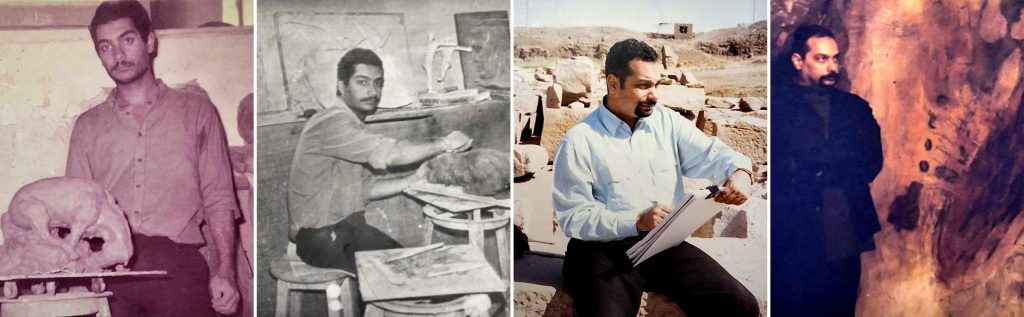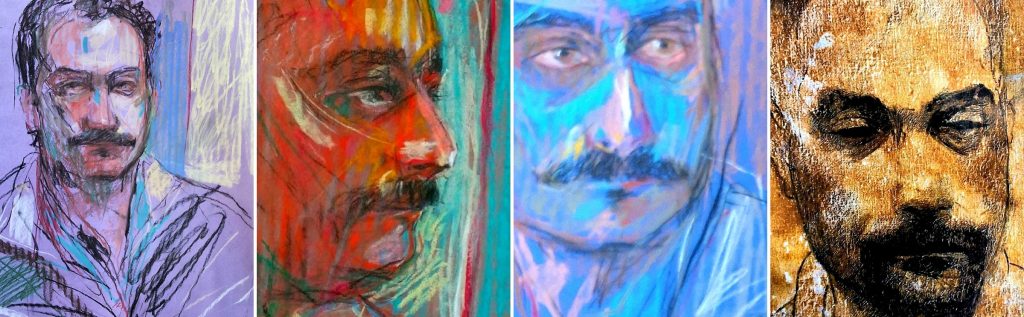
Portraits de Georges Fikry Ibrahim – par Shady El Noshokaty et Ibrahim El-Desouky
Georges Fikry searches for the truth that is the light of the world. He has been exhausted by triangles, and by rotating, zigzagging, and transforming lines – and by people crushed by the feeling that death chases them wherever they go. Then Georges ascends to a height from where he sees them as if he were hovering above them like a desperate mythical bird – and when he draws them, we see nothing but perspective projections revealing their bare heads, the tops of their shoulders, and the soles of their feet and the palms of their hands. And when we contemplate Georges Fikry’s monumental work on paper, we fold our arms to our chests, and shrink upon them, and fold our chests with all that is in them inside our bodies, fearing that those infernal, circling storms embodied by his tragic drawings will catch up with us, and that the fierce desert winds will blow in our wake. For he is an artist – truly – capable of revelation and manifestation, and his distinctive drawings are now climbing the steps one by one, creating their own world, independent in their freedom from the world.(Ahmed Fouad Selim)
يبحث جورج فكري عن الحقيقة التي هي ضوء العالم. أرهقته المثلثات، والخطوط الدوّارة، والمستعرّجة، والمتحولة – والأشخاص الذين يسحقهم إحساسهم بأن الموت يطاردهم أينما حلّ. إذ ذاك يصعد جورج إلى أعلى حيث يراهم وكأنّه يحلّق فوقهم كالطير الأسطوري اليائس – فإذا رسمهم لا نرى منها سوى مساقط المنظور التي تكشف رؤوسهم العارية، وأعلى أكتافهم، ووشوش أقدامهم وأكفّهم. ونحن حين نتأمل عمل جورج فكري العملاق على الورق، نضم سواعدنا إلى صدورنا، وننكمش فوقها، ونطوي صدورنا بما فيها داخل أجسامنا، خشية أن تلحق بنا تلك العواصف الدائرية الجهنمية التي تجسّدها رسومه التراجيدية، وأن تهب في أثرنا رياح الصحاري العاتية. فهو فنان – بحق – قادر على الكشف، والتجلّي، ورسومه المميزة الآن أخذت تصعد الدرجات واحدة تلو الأخرى، منشئة عالمها، ومستقلة بحريتها عن العالم .(أحمد فؤاد سليم)
Fikry’s multifarious work brings to the fore timeless themes in what he describes as “from a certain Egyptian perspective, in a changing society and political context.” Yet his unmistakably abstract style belies any sense of something inherently Egyptian about the piece. Is Fikry in fact saying that despite the evolution (or indeed, devolution) of the political and social system, some basic facts will remain unchanged.But something that Fikry is certainly sure about is the existence of the Faris, the knight, who “may or may not come in the future, yet he belongs to history and defends in the name of the good,” he smiles. “We are all knights.”Fikry’s concern to preserve and give expression to the mythical memory forms the thrust of his artistry, By (Michaela Singer) – Art Curator
يُسلّط عمل فكري المتنوع الضوء على موضوعات خالدة، فيما يصفه بأنه «من منظور مصري معيّن، في مجتمع وسياق سياسي متغيّر»، ومع ذلك فإن أسلوبه التجريدي الذي لا يُخطئ ينفي أي إحساس بوجود شيء مصري أصيل في العمل، فهل يقول فكري في الواقع إنه رغم تطور، أو في الحقيقة تدهور، النظام السياسي والاجتماعي، ستبقى بعض الحقائق الأساسية دون تغيير، لكن هناك شيء واحد متأكد منه فكري تماماً، وهو وجود الفارس، الذي «قد يأتي أو لا يأتي في المستقبل، لكنه ينتمي إلى التاريخ ويدافع باسم الخير»، يقول مبتسماً: «كلنا فرسان»، ويُشكّل حرص فكري على الحفاظ على الذاكرة الأسطورية والتعبير عنها جوهر فنّه (ميكايلا سينجر) – قيّم فني
Egyptian culture, with its roots, is his main theme. Ancient writing, such as hieroglyphics, is among the cultural and philosophical symbols he uses to show the way of life in Egyptian society. There are also elements of sacred architecture and art, such as the pyramids, temples, royal pharaohs, tombs, icons, old Coptic monasteries, Islamic architecture, folkloric elements and narrations. But Egyptian reality is also one of his aims; it is his homeland and his source of inspiration. He returns to its symbols, and sometimes its cultural, social and economic variables also appear in his new works which, through contemporary media, reflect cultural and social changes. The artist says: “My art is narration, expression and the memory of visual forms (Karin Adrian von Roques) – Curator, Middle East and North Africa
تعد الثقافة المصرية بجذورها موضوعه الرئيسي، فالكتابة القديمة مثل الهيروغليفية من بين الرموز الثقافية والفلسفية التي يستخدمها لإظهار أسلوب الحياة في المجتمع المصري، وهناك أيضاً عناصر من العمارة والفن المقدس، مثل الأهرامات والمعابد والفراعنة الملكيين والمقابر والأيقونات والأديرة القبطية القديمة والعمارة الإسلامية والعناصر الفولكلورية والحكايات، لكن الواقع المصري أيضاً من أهدافه، فهو وطنه ومصدر إلهامه، ويعود إلى رموزه، وأحياناً تظهر أيضاً متغيراته الثقافية والاجتماعية والاقتصادية في أعماله الجديدة التي تعكس، من خلال وسائط معاصرة، التغيرات الثقافية والاجتماعية، ويقول الفنان: «فني هو سرد وتعبير وذاكرة للأشكال البصرية»،(كارين أدريان فون روكيس) – قيّم فني
Circular Rotation… Between the Ritual and the Iconic
In his visual treatment, he departed from what he was accustomed to. And I do not mean his handling of color, figures, or textures, but rather that visual perspective of seeing through the idea of the circular form, in the suggestion of its rotation — that is, rotation around the circumference of a circle — moving with it, in his visual presentation, from the lines and fragmented hatchings that distinguished his penultimate exhibition at the exhibition hall of the American University, to a state of gathering the lines and vertical hatchings into a circular direction. That is, rotation around the form, or around the self. Both were aided by the idea of his subjects, characterized by movement and circling around a center of celebration: the سبوع [the seventh-day birth celebration], birth, marriage, the henna night, feasts, and moulids [saints’ festivals]. I will begin with the symbolic aspect, in the artist Georges’ work, of the circular form, from which one can say the halo of sanctity emanates, and which is also the circular form suspended in Coptic iconic art. The circumference of the circle is also a symbol of the image of eternity, or a symbol of infinity, symbols that accord with the eternity of his subjects — from birth, marriage, and the سبوع. The circle is also a celestial or magical symbol in many cultures, as well as in healing circles, and those talismans that form belts, collars, and rings — also in accord with his subjects of feasts, moulids, and dhikr [remembrance rituals]. The artist has done well in choosing the circular support, which is consistent with his subjects that impel movement and circular circling around a center and a subject of celebration. There is also the symbolism of the crimson red color that dominated his paintings. It is the color of blood and the color of wine. The bloody sacrifice of Christ and the winepress form a mystical mixture that I see in the artist Georges. Visually, I find the idea of collective centering toward a center or a focal point in an axial path of a circle, a part of which he may have left open toward the viewer to participate. Perhaps this centering and circling around a point of interest reflects, on the part of the artist, a desire to be a center of interest around which others gather. After his last exhibition and what I saw in it of the dominance of the idea of the finite and the lines of fragmentation, I see him in his latest paintings making the scene open, gathering the vision toward a center, concerned with the visual vision of the crumpling of texture and paper and thickness, which gave me a feeling — as I watched images of his paintings and enlarged small, secluded parts of them — of finding them rich, opulent areas, as if he paints matter and color in every centimeter of his paintings, which reach dimensions of two meters and more. And while I see the figures in his paintings in a state of collective migration toward the center, I see the narrativity of this exhibition, far from his earlier conceptualism, presenting them with a hypothesis different from that traditional vision in depicting the circular direction. Some of his paintings we see as if he captured them from a horizontal distance, as if he is watching the scene from above without participating, leaving the opportunity for participation to the audience. While Georges Fikry gathers the limbs of his figures in a collective form, and their outer edges have been struck by a state of fragmentation of line and its local scattering and its intense hatching, I realize it is not the result of this tearing of the boundaries of their bodies, but rather the result of the speed of their movement around a closed circular circumference, but from the effect of what stirs the conscience of intense emotion, until his intensely red colored papers, in their dark degrees, appeared as if they were bandages stained with blood. But what is striking is that despite the jesting nature of his subjects as celebration, yet by his reliance on circling and heading toward the center, the viewer does not see joy or delight, but rather receives it with a strange, and sometimes terrifying, introverted logic, especially with the positioning of his figures in juxtaposition in a brutal manner of bodies and color, which sidesteps the popular ritual title to highlight for us the grotesque and brutal sensibility in a meeting in which each reinforces the other, especially with his style that scratches the boundaries of the body, until the boundaries of the bodies appeared disheveled, violently present, as if they were in a mysterious magical ritual, or that their rotation will lead them toward the bottom, with the suggestion of a stifling atmosphere without air except from outside the circular circumference. I see that the artist Georges has succeeded in making the identity of the canvas, with its papers, more important than the identity of the subject itself. Before, the identity of the canvas of his intellectual paintings, or the surfaces of his mural papers, was with its fragmented, scattered lines resembling what iron filings are under a magnetic effect. Now he has gathered this intellectual fragmentation by a magnetic gathering toward the center, evoking names for subjects of Rituals of Egypt, to see Georges’ ritual paintings as a kind of nostalgia for this ritual more than an evocation of the ritual itself, and when he evoked it, he placed it in an iconic form dominated by the idea of circular rotation.
By: Fatima Ali, Al-Qahera Newspaper – 2009
الدوران الدائرى .. بين الطقوسى .. والأيقونى
كما أنه فى المعالجة البصرية اختلف عما اعتاد ولا أقصد تناول اللون أو الشخوص أو الملامس لكن ذلك المنظور البصرى للرؤية من خلال فكرة الشكل الدائرى فى إيحاء دورانه أى الدوران حول محيط دائرة متنقلاً بذلك مع عرضه البصرى للخطوط والتهشيرات المتشظية التى تميز بها معرضه قبل الأخير بقاعة العرض بالجامعة الأمريكية إلى حالة من لملمة الخطوط والتهشيرات الرأسية إلى الاتجاه الدائرى .. أى الدوران حول الشكل أو الذات وكلاهما ساعد عليه فكرة موضوعاته المتسمة بالحركة والالتفاف حول مركز للاحتفالية بين السبوع .. الميلاد .. الزواج .. ليلة الحنة .. والأعياد والموالد . وسأبدأ بالجانب الرمزى لدى الفنان جورج للشكل الدائرى الذى يمكن القول إنه تتفرغ منه هالة القداسة وأيضاً هو الشكل الدائرى المعلق فى الفن الأيقونى القبطى . كما أن محيط الدائرة رمز لصورة الأبدية أو رمز اللانهائية وهى رموز تتفق وأبدية موضوعاته من الميلاد .. الزواج .. السبوع كما أن الدائرة كرمز سماوى أو سحرى لدى كثير من الثقافات وكذلك كحلقات علاجية وتلك الطلاسم التى تشكل أحزمة وأطواق وخواتم أيضاً تتفق وموضوعاته عن الأعياد والموالد والذكر . وقد أحسن الفنان اختيار المشد الدائرى الذى يتسق وموضوعاته التى تدفع للحركة والالتفاف الدائرى حول مركز وموضوع الاحتفالية. وهناك رمزية اللون الأحمر القرمزى الذى ساد لوحاته وهو لون الدم ولون الخمر .. فإن التضحية الدموية للسيد المسيح ومعصرة الخمر تشكل خلطاً صوفياً أراه لدى الفنان جورج . وبصرياً أجد فكرة التمركز الجمعى تجاه مركز أو نقطة محورية فى مسار محورى لدائرة ربما جعل جانباً منه مفتوحاً تجاه المشاهد ليشارك .. وربما يعكس هذا التمركز والالتفاف حول نقطة اهتمام من الفنان ليكون مركز اهتمام يلتف حوله الآخرون . وبعدما كان آخر معارضه وما شاهدته من هيمنة فكرة المتناهى وخطوط التشظى لأراه فى لوحاته الأخيرة يجعل المشهد مفتوحاً يلملم الرؤية تجاه مركز مهتماً بالرؤية البصرية من تجعيدات للملامس والورق والثخانة مما أعطى احساساً وأنا أشاهد صور لوحاته وتكبيرى لأجزاء صغيرة منزوية منها لأجدها مناطق ثرية غنية كأنه يرسم المادة واللون فى كل سنتيمتر فى لوحاته التى تبلغ أبعادها المترين وأكثر. وبينما أرى شخوص لوحاته فى حالة تهجير جماعى تجاه المركز أرى حكائية هذا المعرض بعيدا عن مفاهيميته الأسبق يقدمهما بفرضية مغايرة لتلك الرؤية التقليدية فى تصوير الاتجاه الدائرى فبعض لوحاته نراها وقد التقطها من مسافة افقية كأنه يشاهد المشهد من أعلى دون مشاركة ويدع فرصة المشاركة للجمهور . وبينما يلملم جورج فكرى أوصال شخوصه فى شكل تجميعى وقد أصاب حوافهم الخارجية حالة من تشظى الخط وتناثره الموضعى وتهشيراته الشديدة أدركها ليس ناتج هذا التمزيق لحدود أجسادهم وإنما ناتج عن سرعة حركتهم حول محيط دائرى مغلق لكنه من فعل ما يعتمل الوجدان من انفعال شديد حتى بدت أوراقه الملونة الشديدة الحمرة بدرجاتها القاتمة كأنها ضمادات ملطخة بالدم. ولكن المثير أنه رغم مزحة موضوعاته كاحتفالية إلا أنه باعتماده الالتفاف والاتجاه إلى المركز إلا أن الرائى لا يشاهد فرحاً ولا بهجة وإنما يتلقى بمنطق انكفائى غريب وأحياناً مرعب خاصة مع وضعية شخوصه فى تجاور بشكل وحشى للأجساد واللون مما يجنب العنوان الشعبى الطقوسى ليبرز لنا الحس الجروتكسى و الوحشى فى تلاق يعزز كلا منهما الآخر خاصة مع أسلوبه الخادش لحدود الجسد حتى بدت حدود الأجساد شعثاء عنيفة التواجد كأنهم فى طقوس سحرى غامض أو أن دورانهم سيقودهم تجاه القاع بإيحاء الجو الخانق دون هواء إلا من خارج المحيط الدائرى . أرى الفنان جورج استطاع أن يجعل هوية القماشة بأوراقها أكثر أهمية من هوية الموضوع ذاته .. وقبلاً هوية قماشة لوحاته الفكرية أو مسطحات أوراقه الجدارية كان بخطوطها المتشظية المتناثرة تشبه التى تكون عليها برادة الحديد بتأثير مغناطيسى .. الآن هو جمع هذا التشظى الفكرى بفعل جمع مغناطيسى تجاه المركز مستحضراً أسماء لمواضيع طقوس مصر لأرى لوحات جورج الطقوسية نوع من الحنين لهذا الطقس أكثر من استحضار الطقس ذاته وحين استحضره وضعه على هيئة أيقونية تهيمن عليه فكرة الدوران الدائرى
فاطمة علي –جريدة القاهرة 2009
He is considered one of the active artists. The artist Georges is one of the distinguished artists on both the moral and creative levels. He is a simple human being and deeply contemplative. Whoever contemplates him discovers that he is an organic part of his artworks. He loves large mural works, whether paper or composed of parts, according to his idea for the work. His works in black and white, which accept no middle ground, attracted me, dazzled me, and amazed me. With competence he was able to create from them a balanced world… a cosmic, spatial world crowded with its people as if they are looking out from windows on the horizon, and other works in which lines run parallel and intersect and spiral and undulate and launch and scatter, some of which resemble points or severed successive lines. And the light in these artworks melts into the forms to the degree of merging, while preserving the beauty of the line which trembles from the water jars and melts and spreads then straightens its appearance. This emotional rhythm, filled with a great degree of sensitivity, has qualified the artist to formulate his world with confidence, daring, and courage not available in many. Venturing to draw on giant surfaces is similar to the movement of a human jumping to swim in the depth of the ocean. The latent energy in the artist’s self is one of the factors of the artist’s success in transmitting his feeling and sensations to express sincerely. And Georges’ expressiveness is his modern formulation, alternating between abstract expressionism and modern expressionism. And the light here springs from the corners of his room, whose walls and corners inhabit a large living part of his conscience and reflect a pulsating world of his people and a tight harmony of the degrees of his lines and their rhythm. And the dialogue between light and darkness is as it is a dialogue between black and white. And Georges is a distinguished artist and a star with his vision and uniqueness… and his authenticity.
Prof. Dr. Ahmed Nawar 2005
-جورج والضوء العملاق
يعد من الفنانين النشطين،الفنان جورج من الفنانين المتميزين على المستويين الخلقى والإبداعى فهو إنسان بسيط وعميق التأمل، من يتأمله يكتشف أنه جزء عضوى من أعماله الفنية، يعشق الأعمال الفنية الكبيرة الجدارية سواء كانت ورقية أو مركبة الأجزاء وفق فكرته للعمل، شدتنى وأبهرتنى وأدهشتنى أعماله بالأبيض والأسود التى لا تقبل الوسط والتى استطاع باقتدار أن يخلق منها عالماً متوازناً .. عالماً فضائياً كونياً يزدحم بناسه وكأنهم يطلون من نوافذ فى الأفق، وأعمال أخرى تتوازى فيها الخطوط وتتقاطع وتتحلزن وتتموج وتنطلق وتتناثر، منها ما يشبه النقاط أو الخطوط المتواترة المبتورة، والضوء فى هذه الأعمال الفنية يذوب فى الأشكال إلى درجة الاندماج مع الاحتفاظ بجمال الخط الذى يرتعش من جرار الماء ويذوب وينتشر ثم يستقيم ظهوره، هذا الإيقاع الشعورى الممتلىء بقدر كبير من الحساسية قد أهَّل الفنان ليصيغ عالمه بثقة وجسارة وشجاعة غير متوفرة فى الكثيرين ، فالإقدام على الرسم على المساحات العملاقة يماثل حركة قفز الإنسان للسباحة فى عمق المحيط ، كوامن الطاقة فى ذات الفنان تعد أحد عوامل نجاح الفنان فى بث شعوريته وأحاسيسه للتعبير بصدق، وتعبيرية جورج هى حديثه الصياغة، تتواتر بين التجريدية التعبيرية وبين التعبيرية الحديثة .. والضوء هنا نابع من أركان حجرته التى تسكن جدرانها وأركانها جزءا كبيراً حياً من وجدانه ويعكس عالماً نابضاً من ناسه وتآلفاً محكماً لدرجات خطوطه وإيقاعها، والحوار بين الضوء والعتمة كما هو حوار بين الأبيض والأسود، وجورج فنان متميز ونجم له رؤيته وتفرده .. وأصالته. أ.د. احمد نوار جريدة الحياة – 2005
Georges Fikry’s experience moves away from this state of creative begging, and glorifies the Egyptian popular spirit, revealing his long experience extending across different cultures and religions, which the people succeeded in formulating as actions and celebrations and rituals they lived and produced, away from official institutions. This long history is not touched by a single moment of interruption, but rather by successive transformations that urge sanctity and suggest it, away from texts and priests, and empty rituals that satisfy only authority alone. Here man becomes the axis of these manifestations and practices, the product of his spirit and awareness, a resident state of popular religiosity and certainty. Fikry’s works embodied this state and its variations, whether on the level of subject or technique, which approaches to a large degree the method of mural drawings that are discovered successively, as well as the icons that in turn carry images and features of saints. Here the individuals of the people occupy their place, as if they are the most deserving of this attribute, because until now they are able to continue living, and the ability to produce a life formula that belongs to them alone. Themes: Georges Fikry takes the popular theme — customs and rituals — as a way to embody his artworks, including wedding and birth and سبوع celebrations, whether in villages in the north of Egypt or its south, in addition to that the tales and biographies of popular epics extend, such as Antara and Abu Zaid Al-Hilali, and this is something that touches the collective memory of Egyptians, and from it he moves to manifestations of religious and popular celebrations, such as moulids and celebrations of visiting shrines and righteous saints. And in order for the artist to fabricate the idea of continuity and succession of these rituals, he relies in other paintings on scenes from a relatively close memory, such as weddings in popular neighborhoods in the past, and evoking the famous (Hasaballah) band, as well as folk dance circles and the magician and similar manifestations that Egyptian cities and villages lived since the middle of the last century. And from these themes Fikry formulates his tales — where the narrative sense in these paintings cannot be overlooked — in a form of mythical celebration of these creatures and their lives. And between glorification and consolation lies the paradox. Style and Technique: And in order to embody this artistic vision, the artist resorts to the expressive style, and representing the mythical state of the figures, and what they do during the ritual. We notice that the paintings include groups — the collective consciousness of the story — so the idea of the individual is negated, and there is no dominance for the event itself for example, but the importance is in this participation, which raises the value of the event, so there is no heroism except for the group as a whole. Then the circular design that accompanies the paintings, which suggests permanent movement and temporal continuity, and in order to confirm this idea the artist is not satisfied with composition, but in most cases he erases the details of faces, as if the movement of his figures is faster than to be caught. As for color, the artist always uses warm colors, such as red and its derivatives, but not in their pure degrees, but in a pale form suggesting antiquity and the passage of time on these depictions, which confirms the artist’s insistence on the belonging of these scenes to an ancient memory, like a drawing on the wall of an ancient Pharaonic temple, or an icon belonging to Coptic heritage, newly discovered, or glorifying the popular imagination which creates myths of its unofficial heroes, such as the knight who tames a famous lion, which Egyptians always draw on their arms. On the other hand, Fikry uses different mediums in the painting, such as acrylic colors, paper pulp, and colored paper, in addition to the collage technique in some paintings, as if he evokes photographed elements, such as a tea kettle, or fruits and vegetables, as in a painting representing the sellers in the vegetable market. Sad Clamour: And between these human gatherings and their clamour, even that their inclined bodies, which almost fall from the intensity of their rotation in the orbit of their sacred rituals, and despite sheltering in each other, and snatching moments of joy or realization, yet these ecstatic faces hide a great sadness, surpassed by hope, despite all these manifestations. This sadness of saints recurs in all paintings, indeed in some previous exhibitions of Georges Fikry, which clarifies that the state of the artist’s celebration of them takes essentially a ritual form, glorifying these forgotten ones, bringing them out from the museum of memory to the light Mohamed Abdel Rahim – Al-Quds Al-Arabi, Cairo 2020
تجربة جورج فكري تبتعد عن حالة التسوّل الإبداعي هذه، وتمجد الروح الشعبية المصرية، كاشفة عن تجربته الطويلة والممتدة عبر ثقافات وأديان مختلفة، نجح الشعب في صياغتها أفعالا واحتفالات وطقوسا عاشها وأنتجها، بعيداً عن المؤسسات الرسمية. هذا التاريخ الطويل لا يطاله لحظة انقطاع واحدة، بل تحولات متواترة تحض على القداسة وتوحي بها، بعيداً عن نصوص وكهنة، وطقوس فارغة لا ترضي إلا السلطة وحدها. هنا يصبح الإنسان هو محور هذه المظاهر والممارسات، نتاج روحه ووعيه، حالة مقيمة من حالات التدين واليقين الشعبي. جسدت أعمال فكري هذه الحالة وتبايناتها، سواء على مستوى الموضوع أو التقنية، التي تقترب إلى حدٍ كبير من طريقة رسوم الجداريات التي يتم اكتشافها تباعاً، كذلك الأيقونات التي تحمل بدورها صوراً وملامح لقديسين، يحتل هنا أفراد الشعب مكانهم، وكأنهم الأجدر بهذه الصفة، لأنهم حتى الآن يستطيعون مواصلة العيش، والقدرة على إنتاج صيغة حياتية تخصّهم وحدهم. الموضوعات: يتخذ جورج فكري من الثيمة الشعبية ـ العادات والطقوس ـ سبيلاً لتجسيد أعماله الفنية، ومنها احتفالات الزواج والميلاد والسبوع، سواء في قرى شمال مصر أو جنوبها، إضافة إلى ذلك تمتد حكايات وسيَر الملاحم الشعبية، كعنترة وأبو زيد الهلالي، وهو أمر يتماس مع الذاكرة الجمعية للمصريين، ومنه ينتقل إلى مظاهر الاحتفالات الدينية والشعبية، كالموالد واحتفالات زيارة الأضرحة وأولياء الله الصالحين. وحتى يختلق الفنان فكرة التواصل والتواتر لهذه الطقوس، يستند في لوحات أخرى إلى مشاهد من ذاكرة قريبة إلى حدٍ ما، كالأفراح في الأحياء الشعبية قديماً، واستحضار فرقة (حسب الله) الشهيرة، كذلك حلقات الرقص الشعبي والحاوي وما شابه من مظاهر كانت تعيشها المدن والقرى المصرية منذ منتصف القرن الفائت. ومن هذه الثيمات يصيغ فكري حكاياته ـ حيث لا يمكن إغفال الحِس السردي في هذه اللوحات ـ في شكل من أشكال الاحتفاء الأسطوري بهذه المخلوقات وحيواتها. وما بين التمجيد والتأسي تكمن المفارقة. الأسلوب والتقنية: وحتى يتم تجسيد هذه الرؤية الفنية يتوسل الفنان بالأسلوب التعبيري، وتمثيل الحالة الأسطورية للشخوص، وما تفعله خلال الطقس. فنلاحظ أن اللوحات تضم مجموعات ـ الوعي الجمعي للحكاية ـ فتنتفي فكرة الفرد، ولا هيمنة للحدث ذاته مثلاً، ولكن الأهمية في هذه المشاركة، التي تُعلي من قيمة الحدث، فلا بطولة إلا للمجموعة ككل. ثم التصميم الدائري الذي يُلازم اللوحات، وهو ما يوحي بالحركة الدائمة والاستمرار الزمني، وحتى يتم التأكيد على هذه الفكرة لا يكتفي الفنان بالتكوين، بل في الغالب يقوم بمحو تفاصيل الوجوه، وكأن حركة شخوصها أسرع من أن يُقبض عليها. أما اللون فيستخدم الفنان دوماً ألواناً حارة، كالأحمر ومشتقاته، ولكن ليست في درجاتها النقية، بل في صورة باهتة توحي بالقِدم ومرور الزمن على هذه التصاوير، وهو ما يؤكد إصرار الفنان على انتماء هذه المشاهد إلى ذاكرة قديمة، كرسم على جدار معبد فرعوني قديم، أو أيقونة تنتمي إلى التراث القبطي، تم اكتشافها حديثاً، أو تمجيد الخيال الشعبي الذي يخلق أساطير أبطاله غير الرسميين، كالفارس الذي يرّوض أسداً شهيراً، دائماً ما يرسمه المصريون فوق أذرعهم. من ناحية أخرى يستخدم فكري وسائط مختلفة في اللوحة، كألوان الأكريليك، العجائن الورقية، والورق الملون، إضافة إلى تقنية الكولاج في بعض اللوحات، كأن يستحضر عناصر مصوّرة، كبرّاد الشاي، أو الفواكه والخضراوات، كما في لوحة تمثل البائعات في سوق الخضار. صخب حزين: وما بين هذه التجمعات البشرية وصخبها، حتى أن أجسادها المائلة، التي تكاد تسقط من فرط دورانها في فلك طقوسها المقدسة، ورغم الاحتماء ببعضها بعضا، واختلاس لحظات من الفرح أو التحقق، إلا أن هذه الوجوه المنتشية تخفي حزناً كبيراً، تجاوزه الأمل، رغم كل هذه المظاهر. حزن القديسين هذا يتواتر في جميع اللوحات، بل في بعض المعارض السابقة لجورج فكري، وهو ما يوضح أن حالة احتفاء الفنان بهؤلاء تتخذ شكلاً طقسياً بالأساس، يُمجد هؤلاء المنسيين، فيخرج بهم من متحف الذاكرة إلى النور. – 2020 محمد عبد الرحيم أيقونات تمجد الروح الشعبي
An artist who goes to the earth, ignites the fire in his state towards it, and begins from its ashes its features and terrains, he forms and is formed in the colour of the secluded devotee – the ascetic in observing its most important grooves and human sails, from dancing to the grave digger and from the martyr of memory to the reality of the professions of life. His obsession is the homeland of his childhood, in the extension over the squares of observation and play, he moves through forms and touches them, then withdraws as an appendage to see the unity of action in the part and the symbol and the unity of the eye in the signs of movement, and their connotations of the universality of the unity of parts and work, the form plunges with its shadow, the directions extend, and the pigments unite under a rainbow of burnt grays, which paper renders at times, and the vertical extension and the horizon of imagination at other times. Works extended to become a legend of action, for a wall burning with blackness, bodies surging in it, and forms merging, growing greater little by little, silence launches with them into tales of reality and history, heritage bears witness to their origins and the earth to their sad references, it is the tale of the earth and the epic of man in it, formed on the depth of our reality as language and topographic formulations, for a geography of art reciting its civilization, with the specificity of the gushing cloud, and the eye of the bird, and the essence of what contemporary religion holds of familiar ethnicities of intimacy and history.Abdellatif Al-Samoudi – An Artist Who Goes to the Earth.Abdellatif Al-Samoudi
فنان يذهب إلى الأرض، يشعل النار فى حالته اليها، ويبدأ من رماده ملامحها وتضاريسها، يتشكل ويشكل بلون العاكف المعتكف – الزاهد فى الرصد لأهم أخاديدها وأشرعتها الانسانية، من الرقص إلى حفار القبور ومن شهيد الذاكرة إلى واقع مهن الحياة. هاجسه وطن طفولته، فى الامتداد على ساحات الرصد واللعب، يتنقل فى الأشكال ويلامسها، ثم ينسحب ملحقاً ليرى وحدة الفعل فى الجزء والرمز ووحدة العين فى اشارات الحركة، ودلالاتها على كونية وحدة الأجزاء والعمل، ينغمس بها الشكل مع ظله، وتمتد الجهات، وتتحد الأصباغ تحت قوس قزح رماديات محترقة، يحيلها الورق تارة، وامتداد الشاقولى وأفق الخيال تارة أخرى. أعمال امتدت لتكون أسطورة من فعل، لجدار يشتعل بالسواد، تموج به أجساد، وتتماهى أشكال، تتعاظم شيئاً فشيئاً، ينطلق بها الصمت إلى حكايات واقع وتاريخ، تشهد التراث أصولها والأرض مراجعها الحزينة، أنها حكاية الأرض وملحمة الإنسان بها، تتشكل على عمق واقعنا لغة وصياغات طبوغرافية، لجغرافية فن يتلو حضارته، بخصوصية السحاب الدافق، وقرّة الطائر، ومهجة ما يعاصر الدين من أثنيات معهودة الإلفة والتاريخ. .عبداللطيف الصمودي
The artist is the glowing flame in the depths of man, and every creative artist has his philosophy in life, reflected on the surfaces of his paintings as he likes to see it, expressing with his artistic tools and his vision in the depths of inherited subjects in new aesthetic forms for contemporary art.We touch those human feelings and sensations in the subjects of the artist Georges Fikry, where the artist dealt with the tales of man suspended in memory, of heritage and social customs, from weddings and religious rituals to death, in new forms in his expressive surrealist style, where he made his paintings colour symphonies for his artistic compositions, pulsing, linked to dream, ritual and life, as if they accompany the viewer with them on an aesthetic journey, and set out with the artist’s childlike feeling, and translate all that he contemplates and feels.Some of his paintings are dominated by dark colours with the use of scattered colour masses in the painting, but in a wonderful, non-boring harmony, for he is an artist who uses colour with strength and purity, but with something of tragedy in the lines, with a surrealist technique and a style that relies on the imagination of dreams and looking forward to distant hopes, which leaves the viewer in constant questioning of this strange universe in which symbolism mixes with expressionism.
Wagdy Habashi – Artist and Critic
الفنان هو الشعلة الوهاجة في أعماق الإنسان، ولكل فنان مبدع فلسفته في الحياة، تنعكس على سطوح لوحاته كما يحب أن يراها، معبراً بأدواته الفنية وبرؤيته في أعماق الموضوعات الموروثة بأشكال جمالية جديدة للفن المعاصر. إننا نلمس تلك المشاعر والأحاسيس الإنسانية في موضوعات الفنان جورج فكري، حيث تناول الفنان حكايات الإنسان المعلقة في الذاكرة للموروثات والعادات الاجتماعية، من أفراح وطقوس دينية حتى الموت، في أشكال جديدة بأسلوبه التعبيري السريالي، حيث جعل من لوحاته معزوفات لونية لتكويناته الفنية، تنبض مرتبطة بالحلم والطقوس والحياة، وكأنها تصاحب المشاهد معها في رحلة جمالية، وتنطلق بإحساس الفنان الطفولي، وتترجم كل ما يتأمله ويحس به. فبعض لوحاته تغلب عليها الألوان الداكنة مع استعمال كتل لونية متناثرة في اللوحة، ولكن في تناسق رائع غير ممل، فهو فنان يستخدم اللون بقوة ونقاء، ولكن بشيء من التراجيديا في الخطوط، بتكنيك سريالي وبأسلوب يعتمد على خيال الأحلام والتطلع إلى آمال بعيدة، مما يجعل المشاهد في تساؤل دائم من هذا الكون العجيب الذي تختلط فيه الرمزية بالتعبيرية وجدي حبشي. الفنان والناقد
The works are characterized by expressionism, as he extracts the essence of ritual value from the depth of the Egyptian personality. As for the compositions in the paintings, they represent a human state of human gatherings in a collective, intimate and cohesive relationship, woven intellectually and plastically. Human presence is the main element, considering that man is primarily responsible for the stability and permanence of values.
By: Suzy Shukry ,Rose al-Youssef – 2009
تتسم الأعمال بالتعبيرية حيث قام باستخلاص جوهر القيمة الطقسية من عمق الشخصية المصرية، وبالنسبة للتكوينات في اللوحات فهي عبارة عن حالة إنسانية للتجمعات البشرية في علاقة إجماعية وحميمية ومتلاحمة منسوجة فكرياً وتشكيلياً، كما أن الحضور الإنساني هو العنصر الرئيسي، على اعتبار الإنسان هو المسؤول الأول عن استقرار وثبات القيم . . سوزي شكري 2009